


Mercedes has been the benchmark 2026 team, but given it’s only won one of the last six races, what’s behind its dominant start to Formula 1’s Qatar Grand Prix weekend?
World champion Kimi Antonelli led a Mercedes one-two in both practice sessions, four and a half tenths clear of the nearest competition on single-lap pace in FP2 - despite their fastest laps being set on mediums.
Reading into the final classification is a messy endeavour given two red flags disrupted run plans but it actually makes Mercedes’ position even more formidable.
Russell got very close to completing a full lap on softs but did not finish the lap in time - still, his theoretical fastest lap (taking the two sectors he did do on the faster tyre) was some 0.835 seconds faster than the quickest non-Mercedes, Max Verstappen’s Red Bull.
Theoretical best laps FP2
Russell 1m22.683s
Antonelli +0.246s
Verstappen +0.835s
Norris +0.839s
Piastri +0.866s
Hadjar +0.895s
Hamilton +1.284s
Leclerc +1.416s
Mercedes’ advantage was also sizeable when looking at the adjusted long-run pace in FP2. You can slice such analysis multiple ways but accounting for laps in traffic as best as possible Antonelli leads the way, a whopping 0.810 seconds faster per lap than Verstappen's Red Bull.
FP2 long-run average
Antonelli (Mercedes) 1m28.074s
Russell (Mercedes) +0.205s
Verstappen (Red Bull) +0.810s
Hadjar (Red Bull) +1.058s
Norris (McLaren) +1.061s
Piastri (McLaren) +1.173s
*Ferrari didn’t complete a representative long run
Why Mercedes is quick
Mercedes trackside engineering director Andrew Shovlin called it “one of our better Fridays this year” while deputy Mercedes team boss Bradley Lord said Mercedes “hit the ground running” as the car “seems to suit this circuit”.
Lord said there were “very minimal differences” between Antonelli and Russell’s set-ups by the end of the day, with them looking closely matched over both single laps and longer runs. Russell had made some, in his words, “good changes” after FP1 that made him comfortable with the balance.
Lord said the car is “competitive in both the high speed and the low speed. One of the question marks we had was the low-speed performance with the new update [introduced in Malaysia].
“Obviously, this circuit bias is towards the medium and high speed where we know we've definitely made gains.
“So we're making good use of that. Then hopefully it just reflects our ongoing learning about how to get the most out of the car with this package on it.”
So there is an element of Qatar playing to the strengths of the package and nullifying the effect of the Malaysia upgrade having put the car in a narrower performance window, for low-speed corners in particular - even if Mercedes has made gains since then in widening it.
There are far fewer heavy braking zones or tricky corner entries like Mexico, where the W17 struggled more.
The Mercedes drivers, by and large, avoided the balance issues that have been plaguing rivals like Red Bull in Qatar.
“They find the key to fix this balance, and this balance issue we can have here by having a massive front limitation in high-speed, medium-speed corners, without compromising the entry,” Red Bull’s technical director Pierre Wache observed.
“They are able to do that, and we have the work to do to achieve better.”
Plus, the cars are fairly energy-starved in Qatar - particularly through the high-speed corners and main straight - so the efficiency of Mercedes’ energy management package is rewarded here, as it was in Monza and Baku.
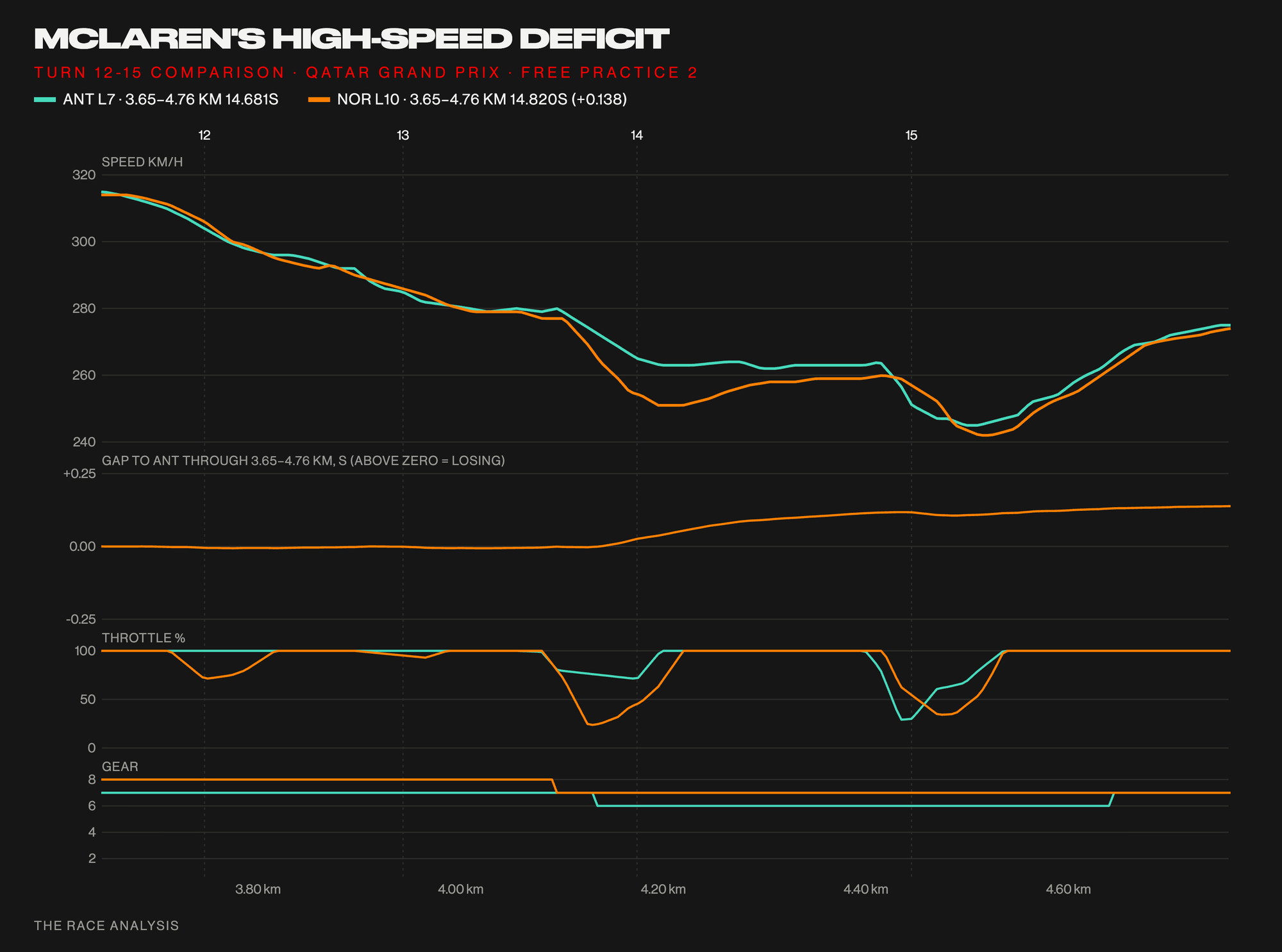
But the fact it still has a significant advantage over McLaren (with that same power unit) and Red Bull (also with a very strong power unit) suggests it has a lot to do with Mercedes’s strength in high-speed corners and it finding a strong car balance that its rivals can’t.
Where Red Bull and McLaren are struggling
Max Verstappen has won four of the last six races, but he was struggling with some familiar problems with his RB22.
He suffered team radio issues early in FP1 that were later resolved, but a “disconnected” balance problem remained throughout Friday.
“It's quite a unique track. It's not an easy track to get things right, so I hope we can do a little bit better,” Verstappen said.
“The gap to Mercedes is very big, so we need a big jump for that. But I think already from our side, if we can get that balance more together, that's probably already half of the laptime that we're losing.”
Verstappen also complained of “heavy steering” in FP2 with Wache admitting, “The car is struggling here a lot in terms of kerbing and stuff that will damage. We have to fix that.”
McLaren’s also wary of the fragility of its car as it started the day on its older specification of floor before switching the drivers onto the new floor introduced in Las Vegas.
“Many people can run off and damage parts, so we just made sure that we didn't damage any of the new spec for this car,” McLaren’s senior racing director Randy Singh explained.
McLaren’s power unit exploitation deficit to Mercedes and known baked-in 2026 missteps like short gear ratios explain some of its gap to Mercedes, who Norris said are “just a different level compared to everyone this weekend”.
“It shows just in general how far off we are.
“It's not like something works better for them here. I mean, you can just clearly see if they're quick here, they're quick in a lot of other places for the same reason.
“So I think it's more a realisation of where we stand relative to them.”
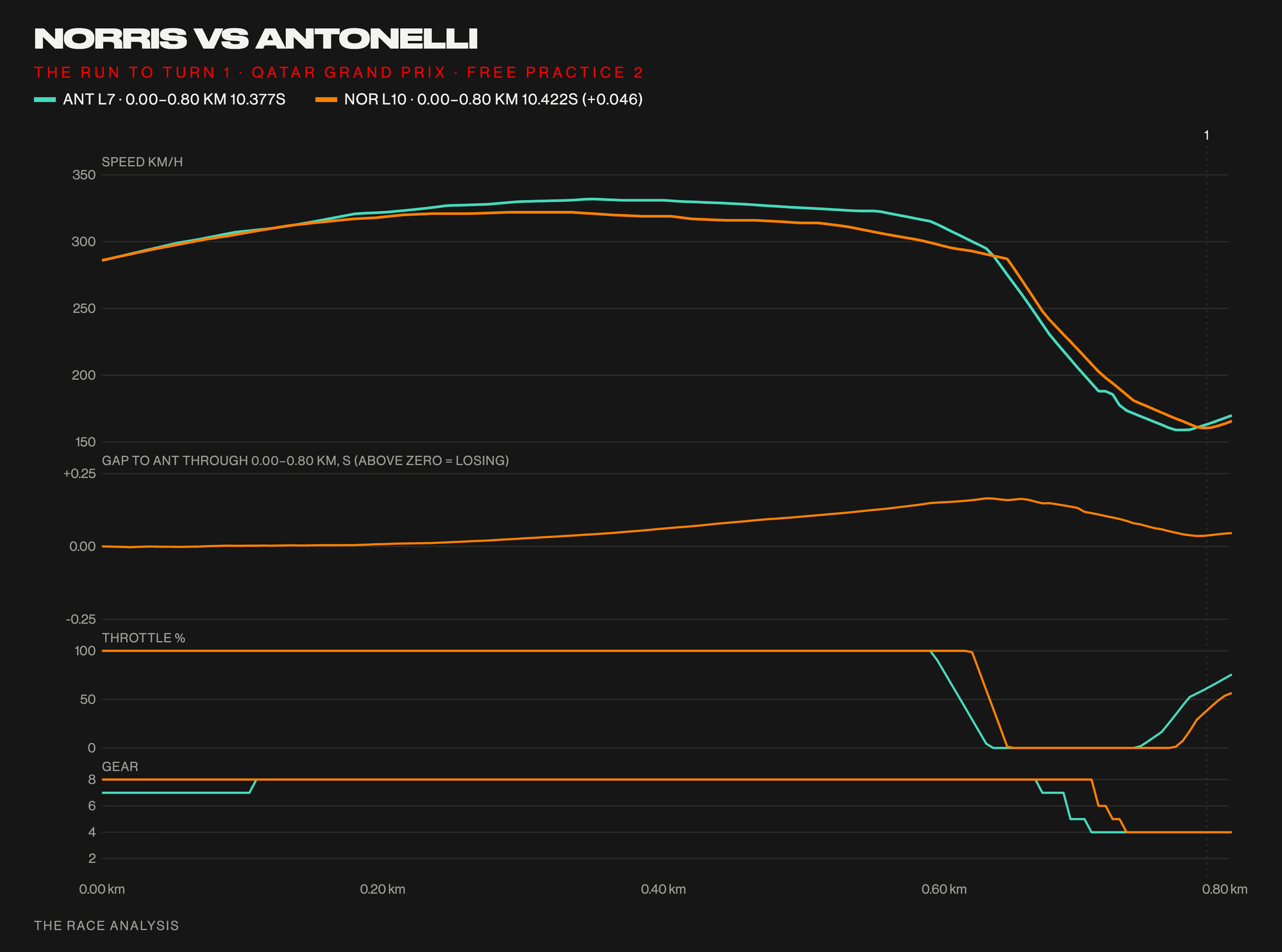
The time loss is most visible on the run to Turn 1, where Norris tops out at 322km/h compared to Antonelli’s 332km/h and has already lost 0.175s by the exit of that corner.
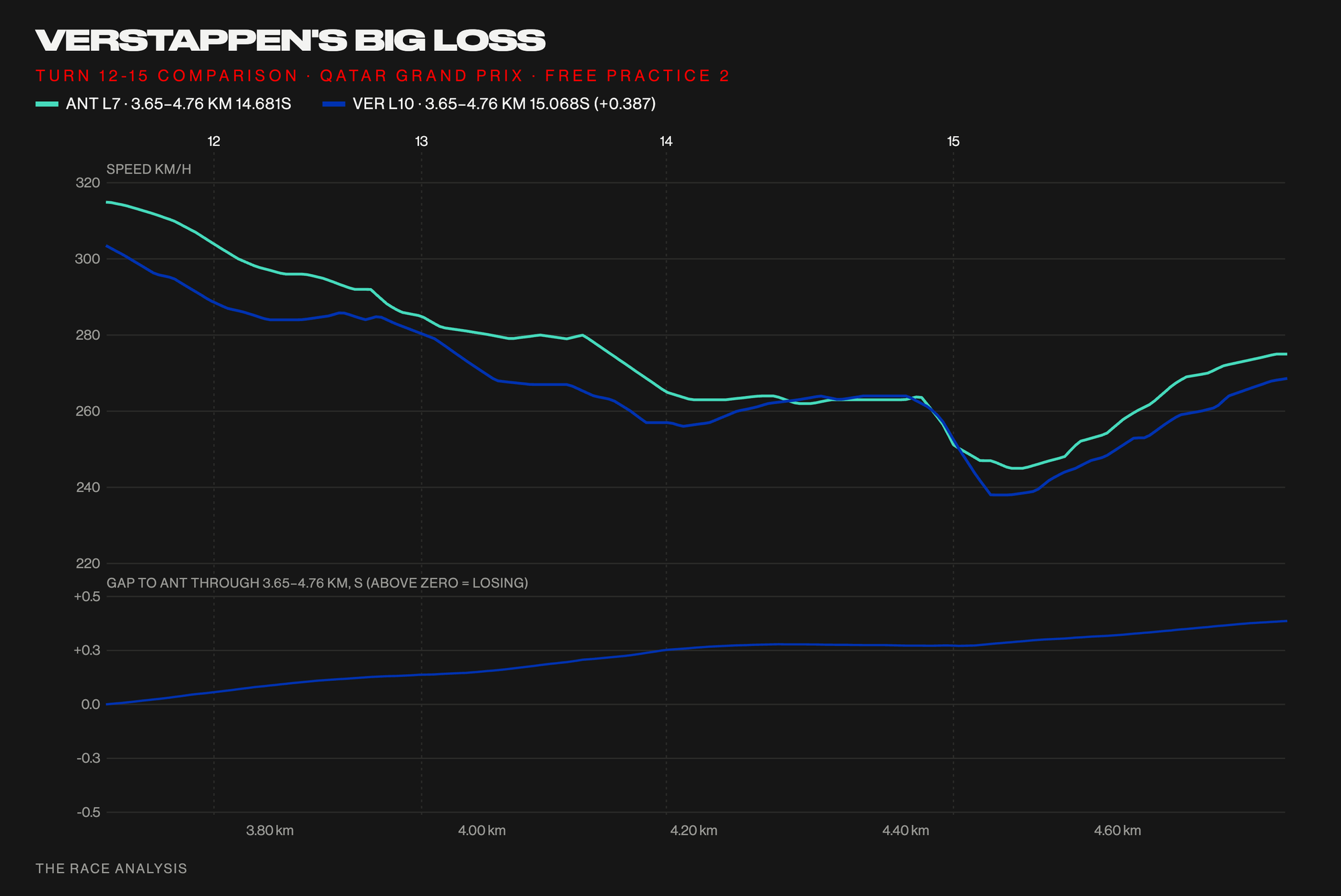
It’s also present in the high-speed corners at Turn 12-15 where Norris loses another 0.125s, as the more planted Mercedes stretches its legs.
The Red Bull ends up leaking even more time there as Verstappen loses over three tenths there alone to Antonelli.
Mercedes has its eye on Red Bull as the “next team”, but Lord said he wouldn’t be surprised to see a five or six-car battle for pole position on Saturday.
There’s clearly one front-running team at risk of being excluded from that fight in Qatar.
What happened to ‘outlier’ Ferrari?
The outlier among the top teams on Friday was Ferrari as its drivers didn’t even manage to complete a representative long-run in FP2. Charles Leclerc spun while Lewis Hamilton stopped on-track with a power unit problem.
“It's been just a very, very difficult session,” Leclerc admitted after FP2.
“When I lost the car, it probably made it even worse, so we just decided to change the floor, which cost us quite a bit of time.
“But to be honest, this is not even the reason why we were slow. We were just very slow from the first lap this morning to the last lap in FP2, and it's very difficult to understand what is the outlier.
“I think not only for us but for everybody, particularly comparing to Mercedes, that seems to be, they always kind of had the best car, but now it's to an extent that we did not expect.”
As you can see from a comparison of their fastest FP2 laps, Leclerc’s laptime bleed to Antonelli is consistent throughout the lap.
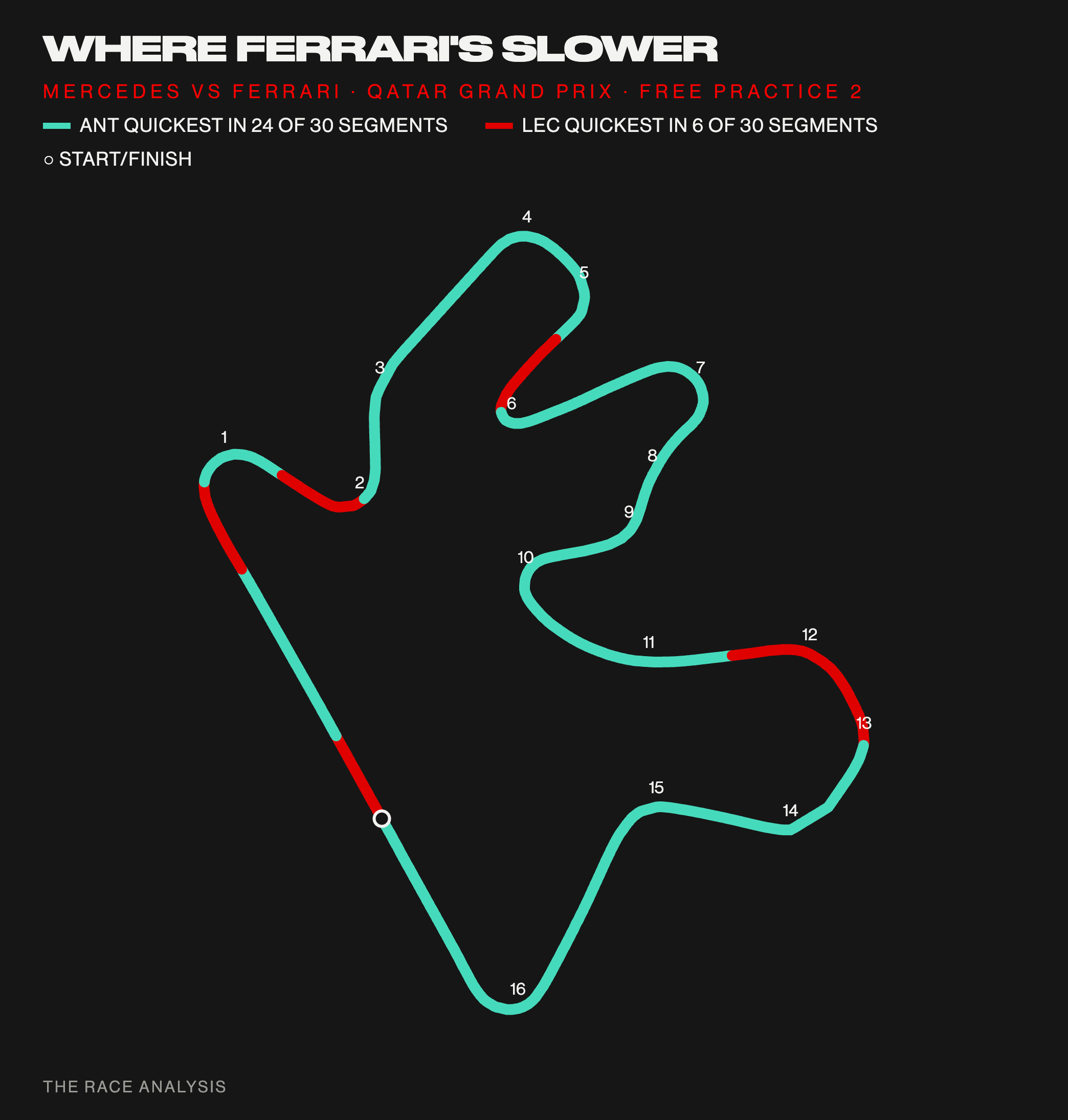
And even on their fastest theoretical laps, there’s major losses in all three of his best sectors - 0.570s in sector one, 0.443s in sector two and 0.484s in sector three.
That’s likely to lead to a long night of head-scratching from Ferrari, Red Bull and McLaren as to why Mercedes appears to be in a different league in Qatar and whether there’s any chance of anyone catching it.