

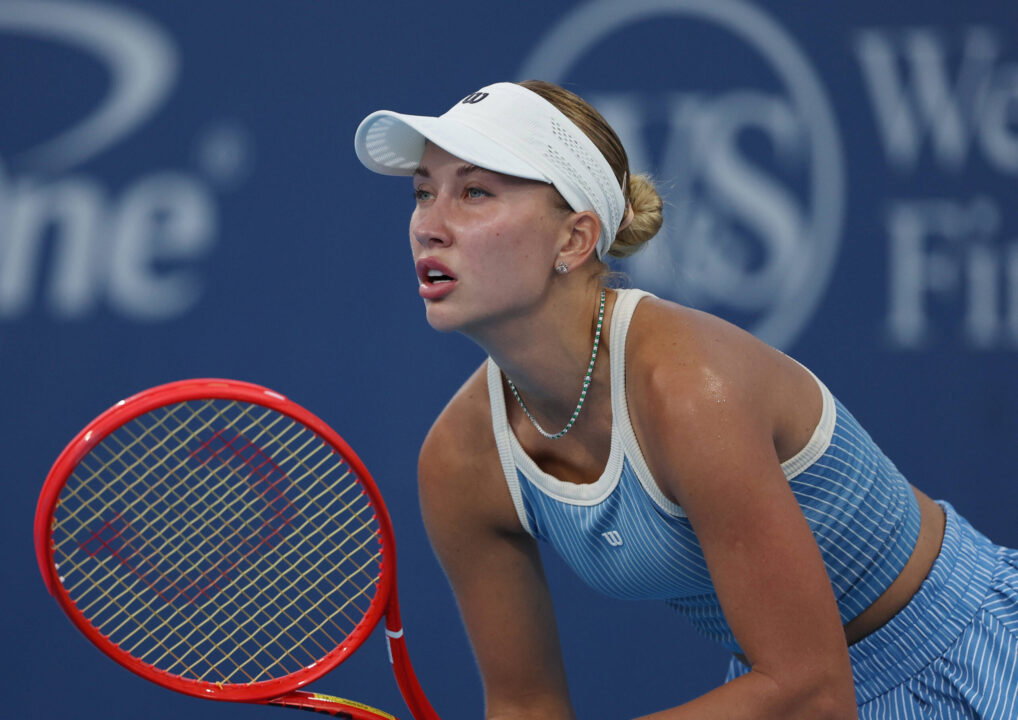
Anastasia Potapova may now compete under the Austrian flag, but her heart, she says, remains firmly in Russia. The 25-year-old, who switched her sporting nationality ahead of the 2026 season, has insisted that the change was a practical necessity rather than a rejection of her roots. In an interview with Russian news agency TASS, Potapova was not afraid to be blunt about her identity, even as she has received backlash from both sides.
“In my heart, I’m still a Russian,” she said. “All reasonable people understand why I had to change [sporting] nationality to make it easier to travel and get to tournaments. I have said this repeatedly, but it does not change who I am as a person, my habits or where I come from.”
“As they say, you can take the girl out of the country, but you can’t take the country out of the girl,” she added. It was an unapologetic framing of a decision she feels needs no justification. It’s not a new stance from her, and Marta Kostyuk had heavily criticized her before.
Before their Madrid Open semifinal in April, Kostyuk made it clear that she would not shake Potapova’s hand, and she stayed true to her word after winning 6-2, 1-6, 6-1. The only Russian-born player she greets, Kostyuk explained, is Kasatkina, who “didn’t just change her passport” but openly said she did not support the war. None of the other switchers, she added, have spoken against the war or in support of Ukrainians, so her position stays the same.
Yet, in May, Potapova, who represented Russia from 2014 until 2025, told Spanish outlet Punto de Break, “I will always have my Russian roots,” adding that her family is still in Russia and that the country has been a fundamental part of her life, even as she worked on settling into Austria, a process she said was going well.
The comments touch on a trend that has reshaped both tours in recent years. Potapova is among a growing number of Russian players who have changed their sporting nationality in recent years, following Russia’s 2022 invasion of Ukraine. Since then, Russian and Belarusian players have been allowed to compete individually on the ATP and WTA Tours only under neutral status, without their national flags or anthems. For the world No. 28, whose career depends on regular access to international tournaments, the logistical case for a switch was clear, and she has repeatedly framed her decision in precisely those terms.
The biggest name rumoured to join that list is the new world No. 2, Mirra Andreeva, who won Roland Garros and the WTA Finals this year. The 19-year-old already lives and trains in France, and speculation about a possible nationality switch has grown. However, she said in January 2026 that she had not even considered a change and had received no offers. Still, former world No. 9 Andrei Chesnokov predicted in September that she would eventually switch, arguing that “the trend now is for everyone to leave.”
The incentives are easy to see. A change of sporting nationality opens the door to team events such as the Billie Jean King Cup, eases visa-related travel difficulties, and connects players to the support structure of a recognised national federation. For Potapova, who played the Billie Jean King Cup for Russia in 2018 and 2019, it also meant a route back into the competition. The move is not without its risks, though. In December 2022, Russian politician Roman Teryushkov unsuccessfully requested that Daria Kasatkina be designated a “foreign agent,” following her public criticism of Russia and its policies.
When Potapova first announced the move, she spoke warmly of her adopted home, describing Austria as “a place I love” where she feels “totally at home,” and expressing a wish to make Vienna her second home. She had been living there for a couple of years, she explained, and the move had been in the works for a long time. The Austrian Tennis Federation welcomed her with a brief “Welcome to the team” statement. Her citizenship was granted under a special provision of Austrian law that allows naturalisation in cases where an individual’s exceptional past and expected achievements are considered to be in the particular interest of the republic.
Results kept coming for her this year. Within six weeks, she climbed from No. 97 into the top 40. Her clay-court season was among the best on tour. Potapova reached the final in Linz, made the semifinals in Madrid after entering the draw as a lucky loser, and reached the fourth round at both Rome and Roland Garros. Her biggest win came in Paris, where she came from a set down to beat defending champion Coco Gauff 4-6, 7-6(1), 6-4 in the third round.
Asked in Paris whether the switch was behind the surge, she called the timing partly a coincidence but added, “I do feel free,” and said she felt the support of Austrian fans, crediting experience, maturity, a changed mindset and a new team around her.
However, her recent claim that she is Russian to the core has complicated that picture for some Austrians.
The remarks were met with a strong reaction in Austria. Economist Florian Ederer wrote on social media that her Austrian citizenship should be “immediately” revoked, a reaction that captured the unease felt by some at the idea of a new citizen professing loyalty to her country of birth.
The criticism, however, has not come from one direction alone. In Russia, the switch was poorly received, with former world No. 1 Yevgeny Kafelnikov, a vice-president of the national federation, dismissively asking what Potapova had “ever won for Russia” before bidding her “good riddance.”
Moreover, her recent comments came from a Gazprom-sponsored exhibition in St. Petersburg, leading to some confusion that failed to dampen criticism from either side. She was also accused of lifting the wording of her announcement from Daria Kasatkina, who made a comparable switch to Australia last year.
The overlap was close to word for word: both posts called the adopted country a welcoming place they loved and felt entirely at home in. Kasatkina quipped on X that they were not from the same agency. Potapova did not deny it. She told reporters she saw nothing wrong because the wording could not be put any better, that her team loved it, and that the media had blown it up because they did not like her. “Who cares about posts, right?” she said, per Reuters.
Kasatkina was less amused in a January interview on Anna Chakvetadze’s First&Red YouTube channel. Her first reaction, she said, was, “You could have come up with your own statement, right?” A nationality switch is a serious step, she argued, and she had put real thought into hers. Kasatkina is also an outspoken critic of the war and of Russia’s anti-LGBTQ+ laws.